Pages

Wednesday, August 31, 2005

Travel Map Musings


Someone wise (I forget who) once observed that "the map is not the territory." This certainly is true: nothing can replace experiencing first-hand the sights, sounds, smells, and tastes of a foreign land. Nonetheless, maps are essential tools for travelers. Without them, we would be lost. Here are some qualities that I look for in a good travel map.

  1. A thorough index: nothing is worse than having to search endlessly for a small town on a map without an index.
  2. Waterproof and tear-proof paper: a travel map is only as useful as the quality of the paper that it's printed on.
  3. Well known travel destinations clearly marked: this won't make Machu Picchu any easier to get to, but at least I'll be able to find it in a hurry.
  4. Mountains and lowlands easy to see: this way I'll know when to take my altitude-sickness pills.
  5. A useable legend with distances in both kilometres and miles: sometimes I'm metric, and sometimes I'm not.
  6. Easy to fold back up: I don't have time to practice origami when I'm on the road.
  7. Reasonable price: travel journalism is a low-rent occupation.
Find travel maps on Amazon.com

Friday, August 26, 2005

Moon on the Rise

I've always used Lonely Planet travel guides religiously, but the third edition of Moon's Oaxaca Handbook might have turned me into a convert. I took the new Moon Handbook along on my recent trip to Oaxaca and was really impressed by the thorough job done by its author, Bruce Whipperman. Service listings are extensive, and there is oodles of well-researched information on history, geography, culture, archaeology, and little-visited destinations. Whipperman's writing is clear, concise, and peppered with interesting facts and asides. The book is also liberally illustrated with his funky black-and-white photos. My only real complaint is that the maps are not indexed, a shortcoming shared with other Moon Handbooks. Lonely Planet still produces many worthwhile guides. However, if LP continues to rest on its corporate laurels and offer us increasingly bland fare, Moon will definitely be on the rise.
Friday, August 19, 2005

Oaxaca Journal


Until I came across Oliver Sack's latest book Oaxaca Journal,I had never heard of the term pteridologist, which apparently means "an expert in the study of ferns." Besides being a fern enthusiast and a neurologist, Sacks is a perceptive and empathetic travel writer. His journal is based on a ten-day tour of the biologically diverse state of Oaxaca that he took with fellow members of the American Fern Society. Sacks eruditely describes the varied flora and fauna that he encounters on his journey. He also paints insightful and affectionate portraits of his eccentric traveling companions and of this culturally rich area of Mexico. The result is a book that will appeal to both fern-lovers and Mexicophiles alike.

Monday, August 15, 2005

Cochineal Farm near Oaxaca, Mexico


One of the more unusual places to visit in Oaxaca is the Cochineal Farm just outside the village of San Bartolo de Coyotepec, about 23 km (14 miles) south of the city of Oaxaca. This compact demonstration farm goes by the grandioise-sounding name of Centro de Difusión de Conocimiento la Grana Cochinilla Tlapanochestli. Cochineal is a natural red dye which dates back to pre-Hispanic times. It is made from crushed insects which the Spanish Conquistadors called grana cochinilla (Dactylopius coccus). These bugs are raised on a variety of Nopal cactus (prickly pear) common throughout much of Mexico. The farm has hundreds of these chubby cacti covered in a white filmy material which is secreted by the insects for camouflage.


At one time cochineal was in great demand in Europe as a dye for textiles, and it is still used by indigenous peoples. Cochineal has recently come back in favor as a natural coloring for food and cosmetics. A small museum at the Cochineal Farm has exhibits and a video on the history, production, and uses of cochineal. There is also a store with postcards and souvenirs dyed with cochineal. The farm is open Monday-Friday 9 am - 5 pm, and Saturday 9 am - 2 pm. Knock on the door and a worker will show you around.

Thursday, August 11, 2005

Sierra Gorda Missions, Queretaro, Mexico


During my latest visit to Mexico, I had the chance to visit the rugged Sierra Gorda region in the state of Querétaro. This area is best known for its five Franciscan missions: Landa, Jalpan, Concá, Tilaco, and Tancoyol. These isolated 18th-century missions are reached by a roller-coaster road that winds through the stark mountains of the Sierra Gorda Biosphere Reserve. This dramatic, cactus-studded landscape is some of the most awe-inspiring that I've encountered in Mexico. The missions all have churches with remarkable baroque facades richly decorated with both Christian symbols and pre-Hispanic indigenous motifs, as well as stylized plants and geometric designs. In 2003, the Sierra Gorda missions were declared a UNESCO World Heritage Site. Mexico now has 24 such sites, more than any other country in the Americas.

Sunday, August 07, 2005

Humboldt's Cosmos


One thing that I would like to do in this blog is pass along the names of worthwhile books that I come across in my travels. During my recent visit to Oaxaca, I bumped into Humboldt's Cosmos at the wonderful Librería Amate bookstore on the Alcalá pedestrian mall. This well-researched and highly readable book by Gerard Helfrich deals with the life and writings of Alexander von Humboldt, perhaps the most famous and influential of the New World's 18th-century explorers. Charles Darwin was inspired by Humboldt's writings, as were many other great thinkers. Here is what Ralph Waldo Emerson had to say about Humboldt:

"Humboldt was one of the wonders of the world, like Aristotle, like Julius Caesar...who appear from time to time as if to show us the possibilities of the human mind, the force and range of the faculties - a universal man."

Wednesday, August 03, 2005

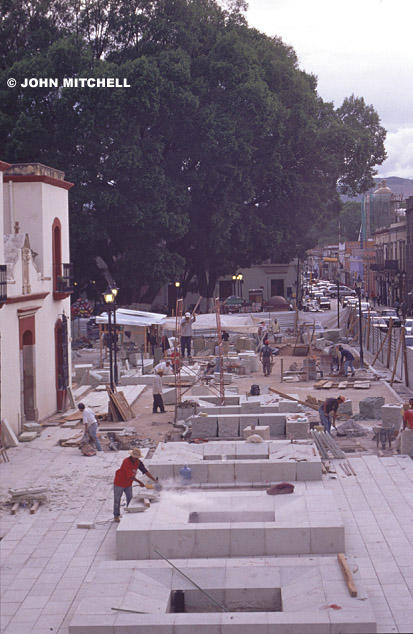
Oaxaca's New Zocalo

Restoration work on the Zocalo in Oaxaca, Mexico. © John Mitchell 2005

The big news in Oaxaca these days is the city's renovated Zocalo (main plaza). It's the heart and soul of Oaxaca and a UNESCO World Heritage Site. So when city authorities decided to rip up the Zocalo without consulting the locals, the move caused a lot of controversy, especially when some of the square's 125-year-old Indian Laurel trees started to topple over. When I visited Oaxaca in late June 2005, things were a real mess (see photo at left). Sidewalk cafés and other businesses around the Zocalo were suffering financially, and people seemed lost without their main public space. Now most of the work has apparently been finished. Check out the Planeta.com and Mexicanwave websites to see the latest Zocalo pictures and read news about the reconstruction. To me, the new Zocalo looks more sterile than the old one, which is a real pity since it was one of the prettiest plazas in Mexico.